

Table of Contents
- Why Hot Sauce Belongs in Your Cooking, Not Just on Top
- How Heat Changes Flavor: What Happens to Hot Sauce in the Pan
- How to Cook with Hot Sauce: A Step-by-Step Approach
- Adding Hot Sauce to Sauces and Marinades (Without Ruining the Balance)
- The Best Hot Sauce for Tacos in 2026 (and Other Everyday Dishes)
- Common Mistakes When Cooking with Hot Sauce (and How to Fix Them)
- Safety Notes for Cooking with High-Scoville Hot Sauce
- Conclusion
- Frequently Asked Questions
Last Updated: September 23, 2026
Why Hot Sauce Belongs in Your Cooking, Not Just on Top
If you've ever wondered is hot sauce good for cooking, the answer is yes because it adds layered flavor, not just heat. Used early, it builds depth into marinades, sauces, and one-pot meals in a way a last-second dash never can. At Pepper Song, we build our small-batch sauces with no added sugar and premium ingredients, so they hold up when heat hits them.
How Heat Changes Flavor: What Happens to Hot Sauce in the Pan
Heat changes hot sauce in two directions at once: it mellows the sharpest edges and deepens the base notes. Simmer a vinegar-based sauce for 20 minutes and the aggressive bite softens into something rounder; push it too far and it turns flat and dull.
Capsaicin Under Heat: Does Cooking Make Hot Sauce Milder or Spicier?
Capsaicin, the compound that creates the burn in chili peppers, is fat-soluble and heat-stable, so cooking does not destroy it. What changes is perception: dispersed through fat or liquid, it spreads across the dish rather than hitting one spot, so the same amount of sauce can taste milder even though the chemistry is unchanged. A long simmer will not tame a sauce that is simply too hot for the dish.
- Dilution and dispersion. Capsaicin binds to fat, proteins, and starches, so the same milligram spread through a stew hits hundreds of bites instead of one spoonful. The Scoville rating does not change, but perceived heat per bite drops.
- Volatilization. At a hard boil or in a screaming-hot skillet, some capsaicin and its companion volatile aromatics escape into the steam. That is why a long uncovered reduction tastes less punchy than sauce added at the end, and why the air above the pan can make you cough.
- Acid and sugar behavior. Vinegar evaporates faster than water at a simmer, so a vinegar-based sauce can taste sharper as it reduces. Sugar caramelizes and then burns, which is where bitterness comes from; a no-sugar-added sauce sidesteps that entirely.
Vinegar-Based vs. Fermented: Which Holds Up Better When Cooked?
- Vinegar-based sauces are an acid-forward emulsion. Some acetic acid cooks off, but pepper solids and salt concentrate. They are forgiving in long-cooked dishes and reliable for deglazing a fond off the pan.
- Fermented sauces (tabasco-style mash or gochujang-adjacent styles) carry lactic acid and free glutamates. The glutamates read as umami and survive heat well, but the lactic tang fades with extended cooking, which is why these shine as finishing sauces or late additions to a braise.
- Blended fruit or sugar-based sauces are the most fragile. Their sugars scorch quickly, so brush them on during the last few minutes of grilling.
A quick test: simmer a teaspoon of sauce with a splash of water for ten minutes, then taste it against the raw sauce. If the brightness is gone, add that sauce at the end; if it tastes deeper and rounder, it can go in at the start.
How to Cook with Hot Sauce: A Step-by-Step Approach
Whether is hot sauce good for cooking comes down to timing, not quantity: the same sauce added at three points produces three different results. Here is the sequence that works for most dishes.
- Taste the sauce first. Heat levels vary wildly between bottles. Know what you're working with before it hits the pan.
- Add a small amount early. Stir a teaspoon into your aromatics (onion, garlic, peppers) as they sauté. This builds base notes into the dish.
- Build the middle layer. Add more with your liquid, whether that's stock, tomatoes, or a splash of water for deglazing.
- Adjust at the end. Taste and finish with a fresh dash for brightness and zest.
- Rest before serving. Give the dish 5 minutes off the heat so the flavors settle and the heat level evens out.
When to Add Hot Sauce During Cooking
Add hot sauce early for depth, in the middle for balance, and at the end for a bright finish. Early additions marry with the aromatics and become part of the dish's foundation; mid-cook additions blend into sauces and marinades; a final dash preserves the sharp, fresh pungency that heat destroys over time.
Adding Hot Sauce to Sauces and Marinades (Without Ruining the Balance)
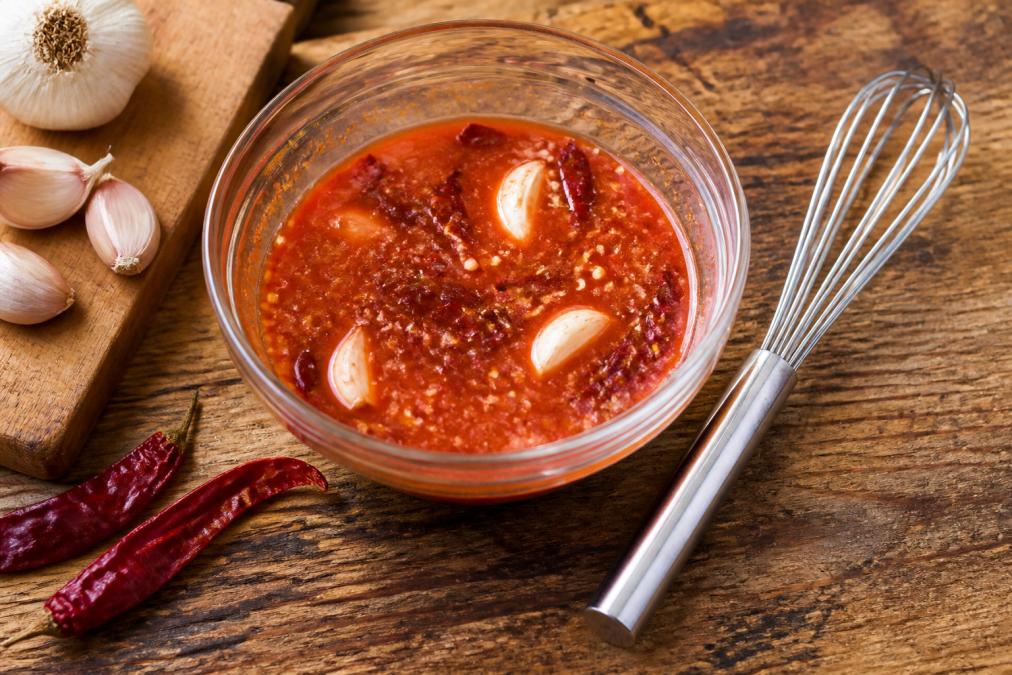
Adding hot sauce to sauces and marinades works best when you treat it as a seasoning with acidity, not just a heat source. The vinegar is already doing work, so you're balancing heat, acid, and salt; get those three right and the sauce tastes complete.
Substituting Fresh Chilis: Conversion Ratios That Actually Work
Substituting fresh chilis for hot sauce is not one-to-one: a jalapeño carries a different heat load and moisture content than a tablespoon of bottled sauce. As a rough guide:
| Fresh Chili | Approximate Sauce Equivalent | Notes |
|---|---|---|
| 1 jalapeño | 1 to 2 tsp mild sauce | Adds fresh, grassy notes |
| 1 serrano | 1 tsp medium sauce | Sharper, more pungent |
| 1 habanero | 1/2 tsp hot sauce | Start small, adjust up |
| 1 poblano | 1 tbsp mild sauce | Mostly for body, low heat |
The Best Hot Sauce for Tacos in 2026 (and Other Everyday Dishes)
The best hot sauce for tacos in 2026 depends on the filling. A bright, tangy green sauce suits grilled chicken and fish. A smoky red sauce belongs with beef, chorizo, and roasted vegetables. A fruit-forward sauce like mango habanero works with shrimp and pork.
Common Mistakes When Cooking with Hot Sauce (and How to Fix Them)
The biggest mistake when cooking with hot sauce is adding it too late and expecting the flavor to spread. A dash at the table sits on top. A spoonful in the pan becomes part of the dish.
- Overheating the pan. High heat scorches sugars and solids, turning a sauce bitter. Keep the pan at a steady medium, and treat any sugary sauce like a glaze added in the last few minutes.
- Adding sauce to a dry pan. Without fat or liquid it burns instead of infusing. Add it with oil, stock, or butter so the capsaicin has something to bind to.
- Using too much at once. Heat builds as a dish reduces, so start with less than you think you need, especially with an unfamiliar sauce.
- Skipping the taste test. Every bottle is different. Taste before you commit the whole dish.
- Reusing a marinade that touched raw meat. Any liquid that has held raw protein must be boiled before serving or reuse. This food-safety rule applies to hot-sauce marinades like any other.
- Adding a fermented sauce at the start of a long braise. The umami survives but the tang does not, leaving a flat sauce. Save fermented styles for the last five minutes.
- Assuming a long simmer will tame a sauce that is too hot. Capsaicin does not break down at stovetop temperatures; dilute with fat or dairy instead of cooking longer.
The High-Scoville Mistake Almost Everyone Makes
- Ventilate before you start, not after. Turn on the exhaust hood and crack a window before the sauce hits the pan.
- Keep the heat moderate. A gentle simmer releases far less aerosolized capsaicin than a rolling boil or hard sear.
- Add high-Scoville sauces late and off the heat when possible. Stir them in during the last minute or after the pan leaves the burner.
- Wear gloves when handling the bottle or measuring. Capsaicin is not water-soluble, so water alone will not remove it from your hands; soap and oil work.
- Keep your hands away from your face. The compound that burns your skin will burn your eyes.
If you get a mouthful that is too hot, reach for dairy, not water. Milk, yogurt, and sour cream contain casein, which binds capsaicin and carries it away; water just spreads it around. Bread and rice help mechanically, but dairy is the reliable fix.
Safety Notes for Cooking with High-Scoville Hot Sauce
High-Scoville sauces demand respect. Capsaicin is not water-soluble, so rinsing a cutting board or your hands with water alone won't remove it. Use gloves when handling very hot sauces, and keep your hands away from your eyes and face.
Conclusion
Cooking with hot sauce rewards patience and timing more than heat tolerance. Add it early for depth, mid-cook for balance, and at the end for brightness. Taste as you go, respect the Scoville rating of what you're pouring, and let the sauce work with your dish instead of over it.
Frequently Asked Questions
Can I cook with hot sauce or is it only meant as a finishing condiment?
You can absolutely cook with hot sauce. It works as a base note in marinades, a deglazing liquid, a simmering sauce, and a flavor infusion for one-pot meals. The key is matching the sauce style to the technique. Vinegar-based sauces like a jalapeño green hold up well in quick sautés and marinades, while fermented or thicker sauces bring depth to longer simmers and reductions. Adding hot sauce during cooking lets the flavors meld, rather than sitting on top as a raw condiment.
Does cooking hot sauce make it spicier or milder?
It depends on how long and how hot you cook it. Capsaicin, the compound behind the burn, is fat-soluble and fairly heat-stable, so a quick sauté or simmer mostly preserves the original heat level. Long, high-heat cooking can degrade some capsaicin, making the sauce feel milder, but evaporation also concentrates the remaining solids and acidity, which can make the flavor sharper. Taste as you go and add more sauce near the end if you want a brighter, more pronounced kick.
What is the best hot sauce for tacos in 2026?
For tacos, look for a sauce that balances heat with acidity and body so it complements seasoned meat, fresh salsa, and lime rather than fighting them. A rich, smoky red like Anytime Red ($12) works for beef, chorizo, and roasted veggie tacos, while Mango Habanero ($12) brings a fruit-forward sweetness that pairs well with shrimp and chicken. Both are small-batch, made with no added sugar, and built to layer flavor instead of just delivering heat.
How do I balance heat when adding hot sauce to sauces and marinades?
Start with a small amount, taste, and build up. Acid (vinegar, lime, citrus), fat (oil, butter, cream), and sweetness (fruit, honey, caramelized aromatics) all soften perceived heat. If a marinade gets too spicy, add a splash of acid or a spoonful of fat rather than more liquid, which dilutes flavor along with heat. For high-Scoville sauces, use them as a finishing drizzle or a measured accent in the base, not as a free-pour ingredient.
0 comments